How we built Draper's AI stack: automate the routine to amplify the human work
Written by Michelle Kwok, Andrew Hyun, and Patrick Blumenthal
Two years ago, Draper's company data lived in eight Excel sheets. People dropped them into AI chats and hoped the models would be able to parse really complex data. And therefore, all workflows were siloed, with limited visibility, and no cohesive automation.
The team was spending hours a week asking around for this siloed data that lived in other people's chats or inboxes. Asking for contacts we weren't sure we had, updates from founders scattered across inboxes, meeting notes that weren't transcribed, puzzling together a competitive landscape, the list goes on. Instead of incessantly information gathering manually, they could have spent this time being present with founders, making judgment calls on teams, and digging deep into emerging industries. The human work that AI cannot do.
Today, we've centralized all of that data into an evergreen base that is auto-updated with our companies' latest moves, from their key numbers to their weekly updates, via a series of automated workflows that everyone has access and visibility into.
Every company and founder, from the second we meet them to every follow-on check, has one singular record that is automatically updated with every new piece of info, every automatically transcribed meeting (using Otter.ai), and every update that any of our team members receives.
We've built a custom machine learning model to read through the hundreds of inbound deals we get every week, score them against four decades of our own decisions, and surface the most promising leads for our investment team to take over on. To keep us on top of every situation, our AI system briefs us on the day's meetings and the most urgent matters across our 400+ portfolio companies.
To best service our founders, our system drafts warm intros for them from a network of 15,000+ contacts.
And to wrap it all up with a bow, all this internal data was vectorized so that it could be used for semantic search, and we can now query it with confidence via our own MCP server.
We built our AI infrastructure to get to know more founders, expand our information gathering abilities, keep our internal data and ops smooth and easy to access, and really just take the routine work off everyone's plate, so that we can get into the human part of this job. Meeting people, making the final judgment. The critical thinking that AI cannot yet do in VC, at such an early stage of investment.
Huge thank you to Tim Draper, who inspired this journey. He challenged us to build repeatable infrastructure that could help our team answer every founder who reaches us, find the ones who haven't told anyone they're building yet, and service our own portfolio founders better every day.
The rest of this piece covers the five decisions we made before building anything, then each tool and what it runs on, and ends with the whole stack in one list.
Five decisions shaped everything we built
The first and most important one had nothing to do with AI. We decided where our data would live: those eight spreadsheets became one Airtable base, one record per company, and everything since has either fed that base or been built on top of it. Because we centralized from the beginning, every tool works from reliable, evergreen data, and each automation keeps the base current for the next one. Without that, the same tools would be automating on top of stale exports.
The second was to build on infrastructure we already own. Everything here runs on Airtable, Zapier, Power Automate, Google Drive, Slack, Claude, and Railway for the services we host ourselves. Every person on the team had their own workflow, so we wanted to custom build instead of buy off-the-shelf, to increase adoption and comfort for each team member. We added no new vendors and no external middleware, so when something needs to change we edit a prompt or a Zap rather than ship a deploy. (No-code automations for the win!) We customized the judgment inside the tools, because that part has to be ours: an off-the-shelf lead scorer doesn't know Draper's thesis or the companies we passed on, and a generic meeting brief doesn't know which meeting is a founder's first.
The third decision was about people: MBA interns at Draper pitch a tool to build on top of our foundation in their interview the way a founder pitches a company. Then they get the guidance, infrastructure, and the mandate to ship it to production. It's the same bet we make on founders.
The fourth was a rule for anywhere the data has to be right: when an automated system isn't sure, it stops and asks a person on the investment team instead of guessing.
The last decision was to document every tool the way we'd ship a product: what it is, why it exists, how it was built, how to use it, with a video walkthrough, so the next person can pick it up in five minutes and keep building.
A forwarded email creates the singular record each company will have in perpetuity at Draper
The foundation of the whole system is also the simplest part. To add a new deal, anyone on our team forwards the founder's inbound pitch email to a dedicated internal inbox, and the full opportunity record is created automatically: an AI-written company summary, the round, and the pitch deck converted to a PDF and attached.
To log a founder update, we forward it to another inbox, and it lands on the right company's already-created record automatically, matched by the founder's email domain, with the key numbers extracted.
New contacts work the same way, straight into our network map. And when a meeting lands on a calendar, Otter.ai automatically transcribes it and the notes are immediately tagged to the right company's record.
The same records can be created inside Claude through our MCP server: paste the founder's thread, review the preview, and it writes to Airtable, from a phone if that's where you are. This habit keeps the base evergreen without anyone doing data entry, and our team spends those minutes with founders instead.
From the second they pitch us in an email, to every meeting we have, to every follow-on investment we make, the company has one singular record here at Draper, tagged with all their relevant information, automatically.
Draper Brain answers questions from the firm's own records
Draper Brain is our own MCP server, a custom connector that plugs our internal data directly into Claude, so anyone at the firm can get answers from our records in plain English: 15,000+ contacts, records on every one of our 400+ portfolio companies, 4,900+ co-investors, and 1,900+ meeting notes, all vectorized for semantic search and reachable from a phone. It pulls from our Airtable and our Google Drive, and for companies outside our records it adds filtered private company data from Harmonic, a licensed dataset covering more than 35 million companies.
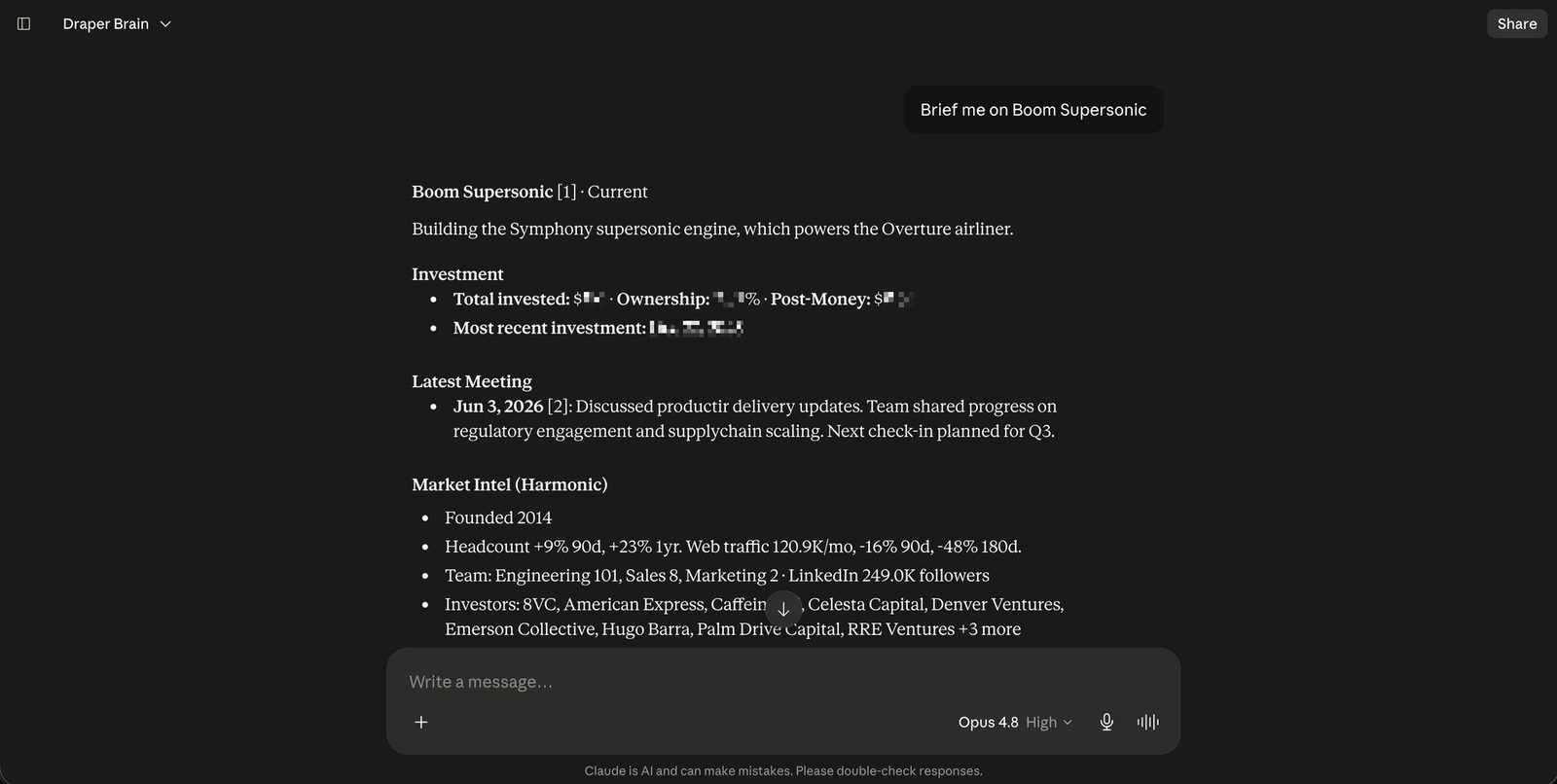
It writes too: paste a founder's email thread into Claude and it creates the deal record, converts the deck link to a PDF, attaches it, and pulls the contents into a summary. Mapping a competitive landscape for an investment memo used to take half a day of research. It now takes minutes.
The Deal Engine handles a different problem: picking which of hundreds of companies to get to know first.
The Deal Engine narrows hundreds of companies to the top 5 that best fit our thesis
We trained a machine learning model on our entire history: every company we screened, backed, passed on, or watched exit. Every week it ingests the newest startups from Harmonic's API, which returns every company in the same consistent shape a model needs, scores each one on eight dimensions, founder DNA and contrarian thesis among them, and emails our investment team the ones that look like a real fit for us. Out of the hundreds of companies every week we could plausibly talk to, it surfaces the top 5 or so that fit our thesis best, so our investment team's time goes to the founders we're most likely to back. Feed it a check size and valuation assumptions and it returns bull, base, and bear MOIC cases, and it retrains as real outcomes come in.

The recurring work runs on a schedule
Every weekday morning, a brief on the day ahead lands in each of our inboxes. It runs as a scheduled Claude task with no custom hosting. The system reads Outlook with read-only access, discards cancelled events and duplicate holds, checks every external attendee against our CRM, and has an AI read the actual email history to judge whether a meeting is a first conversation or a continuing one. When it isn't sure, it labels the meeting a first conversation and flags it for a person, because a founder's first meeting with us deserves our best. The brief also surfaces the most urgent matters across our 400+ portfolio companies, and research agents prep each meeting: who we're meeting, where things stand, what to ask.
Founder updates used to pile up across five inboxes throughout the whole team. Now every update lands on the company's record with ARR, runway, milestones, and raise status extracted, and any company that has gone 60 days quiet gets flagged so we reach out early and ask how we can help.
Each week, our finance lead sends the fund models as Excel attachments, so we have a scheduled Claude task that reads them and updates our invested amounts, ownership, valuations, and LP value into every portfolio record, moving newly funded deals to Committed. When a match is uncertain, the task writes nothing and asks a person on Slack.
Our LP investments get the same treatment. One of the Draper entities is an LP in more than 80 venture funds, and that portfolio lived in scattered spreadsheets too. A fund email forwarded to a dedicated inbox with a trigger word now gets logged, run through AI pre-diligence against our GP evaluation framework, and returned as a snapshot with green flags, red flags, call prep, and a meet recommendation. That pipeline is Zapier end to end, and a scheduled Claude task assembles the report that arrives every Thursday at 4pm, showcasing the funds we're looking at, the potential dealflow we could share, and any actions that are left to be done, just so that nothing falls through the cracks.
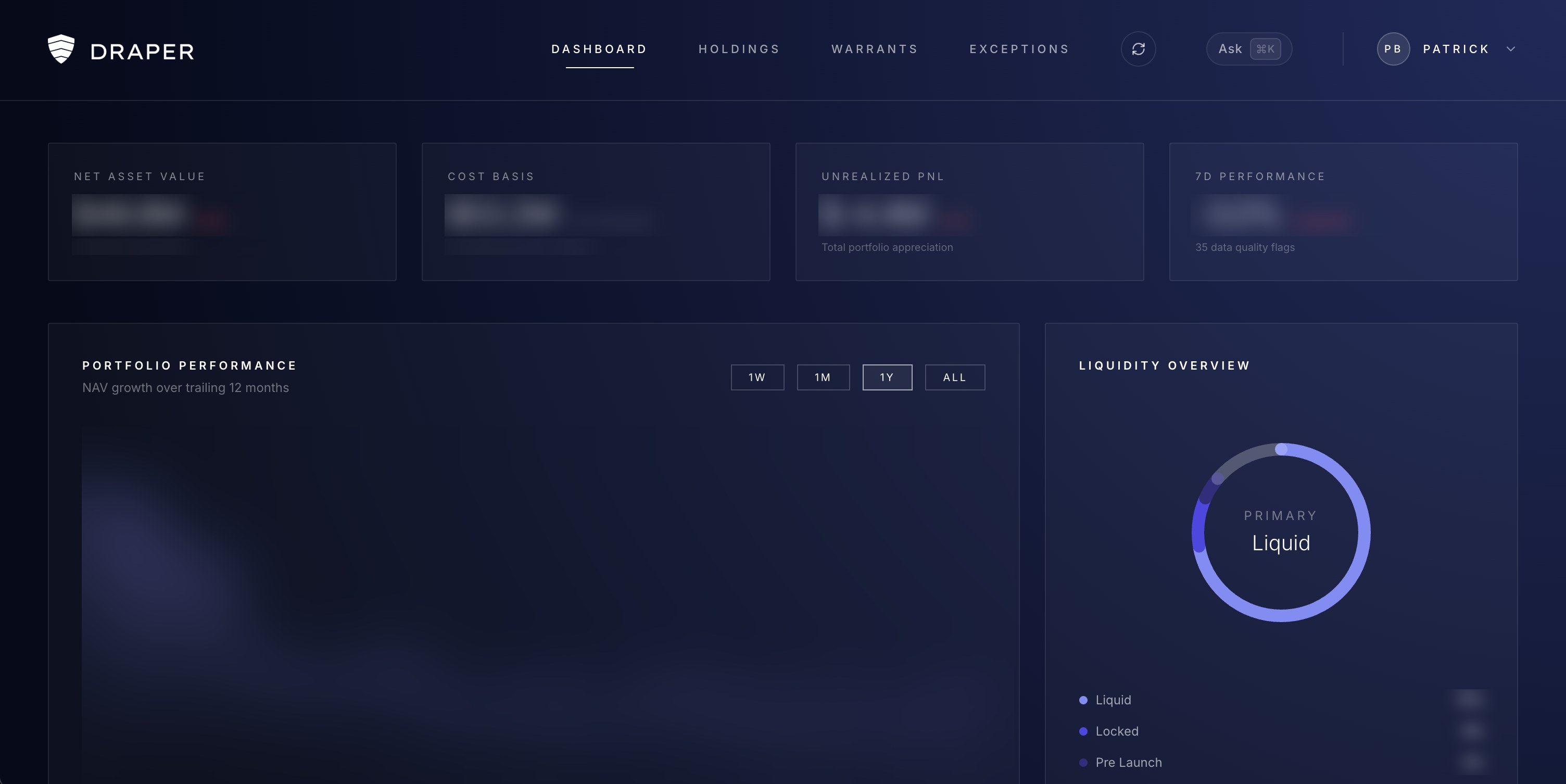
Our crypto book has its own dashboard, built in-house because much of its value sits in locked, vesting, or pre-launch tokens that normal portfolio tools can't represent. It tracks every unlock schedule and answers questions in plain English.
A single form handles founder intro requests
Our founders see one piece of this directly. We rebuilt our founder hub around quick actions, perks, and discounts, and the warm intro requests that used to arrive over email, text, and WhatsApp became a single Airtable form. A founder submits it, a Zapier flow calls Draper Brain to search our full network, and a ready-to-send opt-in email lands in an investment team inbox. Usage is up 10x since the relaunch.
The whole stack at a glance
- Adding deals, updates, and contacts: dedicated internal inboxes, parsed by Zapier flows into our Airtable base. The same records can also be created directly through our MCP server in Claude.
- Meeting capture: Otter.ai transcripts tagged to the company record automatically.
- Lead and opportunity scoring: Airtable automations calling a language model.
- Deck capture: the MCP server converts DocSend, Drive, Slides, Dropbox, and OneDrive links to PDFs and attaches them to the record.
- Draper Brain: our custom MCP server, hosted on Railway, reading Airtable, Google Drive, and Harmonic's licensed external data, vectorized for semantic search.
- Deal Engine: our custom ML model and web app trained on our deal history, with Harmonic's weekly feed of new companies, emailed to the team weekly.
- Daily briefs: a scheduled Claude task reading Outlook (read-only), our CRM, and portfolio updates.
- Fund financials sync: Power Automate plus a scheduled Claude task reading the weekly Excel models.
- LP fund platform: Zapier plus a scheduled Claude task, fed by fund emails to a dedicated inbox.
- Warm intros: an Airtable form and a Zapier flow that calls Draper Brain.
- Crypto dashboard: our in-house web app tracking token positions and vesting schedules.
Three of those are custom in-house-built software: the MCP server, the Deal Engine, and the crypto dashboard. The rest run on the same Zapier, Airtable, and Claude accounts we already had.
Each tool improves the data the others rely on
None of these tools stands alone. The Deal Engine trains on records the weekly syncs keep current, and the morning brief reads the same base that the forwarded emails and lead scores keep rich. Each new tool starts from data the others already maintain, which is the payoff of putting everything in one place first. The time it frees up goes back to meeting founders and making the final judgment.
The AI gave us back the part of venture capital that has to stay human
The point of all this was never about building AI to build AI. It was the hours. The data entry, the deck chasing, the founder updates scattered across inboxes, the contacts we didn't know we had, the half day of competitive research before a memo, all of that used to sit between us and the work only people can do. Now it runs on a schedule and lands in one record, so our team spends that time in the room instead. Being present in a founder on their first call, instead of desperately searching for pre-meeting info and previous notes. Asking the question the model would not have thought to ask. Making the judgment call on a company with three employees and no revenue, where the only real signal is the person in front of you. AI gave us back the part of venture capital that has to stay human.
On this page
More from newsroom

Draper Associates Launches Fund 8
Our $300 million early-stage flagship fund, backing the founders of the future.
Read →
Draper Associates is happy to announce the launch of DA8 after spinning out from DFJ 12 years ago. This is Tim Draper's 41st year in the venture capital business, and 12th year since we relaunched the Draper Associates brand with outside investors.
Our strategy remains consistent. We back exceptional, iconoclastic founders early, ones using excellent, deep technology to go after industries that haven't been disrupted in 20+ years.
With our strategy, we hope to help entrepreneurs advance humanity and make massive anthropological leaps forward.
In addition to providing first investments in Tesla, SpaceX, Hotmail, Skype, and Baidu, the team's recent early-stage investment successes include Bitcoin, Robinhood, Iceye, Oklo, Coinbase, Xanadu, Polymarket, and Colossal.
Tim Draper, Andy Tang, and our whole investment team welcome our new limited partners and founders as they join the exciting Draper journey!

Welcome to the Draper Newsroom
One home for our fund news, portfolio milestones and bold ideas. Published by us, no magazine in the middle.
Read →
We wanted a place to tell our own story, on our own terms, without waiting for someone else to write it. So we built one.
From here on, fund announcements, portfolio milestones, and the ideas we are thinking about will land here first.

Draper Associates Co-Leads $100M Series A for Scout AI
We co-led Scout AI's $100M Series A to build Fury, the AI brain that lets fleets of unmanned defense systems act on a single command.
Read →
We co-led Scout AI's $100 million Series A because the next decade of defense will not be decided by who has the most hardware. It will be decided by who has the best software running it.
The AI brain for autonomous defense
Scout AI is building Fury, a vision-language-action model that turns a commander's intent into coordinated action across fleets of drones, ground vehicles, and unmanned craft, including in the GPS-denied and communications-jammed conditions where today's systems fail. Think of it less as a better drone and more as the brain that lets thousands of them act together.
Founders Colby Adcock and Collin Otis started the company in 2024. In its first year, a team of 34 people booked $11 million in Department of War contracts, unveiled an orchestration layer called Ox, and publicly demonstrated a fully autonomous strike mission run end to end by AI agents.
Why we backed it
We have spent years backing founders who take on hard, unglamorous problems before the market is ready. Autonomous defense is one of the hardest. The round, which we co-led with Align Ventures, was oversubscribed and drew in Decisive Point, Booz Allen Ventures, and a deep bench of defense and venture investors.
“Scout AI is exactly the company this moment demands.”
Tyrone Lee, Draper Associates
Founder Colby Adcock put it more bluntly: this historic raise is a signal to every patriot in Silicon Valley. We agree, and we are proud to help build the brain behind the West's autonomous edge.